
Can tourism work for Wales?
The economic benefits of tourism are not distributed evenly within communities and their workforce. Former CLES Q-Step data intern Jasmine Barry conducted analysis on the impact of holiday homes and ownership, pay and conditions in the hospitality industry to understand how a sustainable model of tourism can benefit people and places.
Tourism plays a major role in the UK economy, contributing 5 per cent of gross domestic product (GDP), supporting nearly one in fifteen jobs, and generating over £50bn in tax revenue in 2024. Yet these benefits are not always shared evenly. In many destinations, rising visitor demand has also put pressure on local communities – pushing up housing costs and increasing reliance on low‑paid, seasonal work.
New analysis, conducted by our 2025 Q-Step data intern from the University of Manchester Jasmine Barry, explores how these dynamics have played out in rural Wales, a popular domestic holiday destination where the negative impacts of tourism activities on the liveability of communities has been well publicised.
The pressures from holiday homes on housing supply are having a negative impact on popular tourist destinations in rural, coastal North and West Wales
While tourism is essential to the Welsh economy, the way it currently operates creates pressures for rural communities and is unsustainable for residents and workers.
Analysis of council tax and business rates data suggests that about 2 per cent of all Welsh dwellings were holiday homes in 2024/25.
However, this figure was significantly higher in rural, coastal areas with higher visitor numbers as well as higher concentrations of fluent Welsh speakers such as in West and North Wales. Gwynedd had the highest proportion of holiday homes as a part of all housing stock (11 per cent), followed by Pembrokeshire (10 per cent), Anglesey (8 per cent) and Ceredigion with (6 per cent). These four local authorities contained nearly three out of five Welsh holiday homes despite being home to only one in 10 Welsh residents.

In these four areas, the cost of a typical home is more than five times the typical annual salary, making housing less affordable than the Welsh average in 2023.
While these local authorities are not the most unaffordable in Wales, ward-level data shows even higher levels of housing unaffordability in tourist areas such as Llŷn Peninsula in Gwynedd, east cost of Isle of Anglesey, west coast of Ceredigion and Newport in Pembrokeshire.

Over time, rural tourism has driven housing supply away from private rentals toward more holiday homes. The Bevan Foundation argues this is because landlords can earn far more from Airbnb than from private rentals in rural Wales.
This shift has benefited owners of multiple holiday homes and hosting platforms. A study by the Bevan Foundation shows that in 2022, over half of all Airbnb properties that are suitable for long-term habitation are managed as part of larger portfolios and almost one in five are managed by a host or agency outside of Wales, including one in four Airbnbs in Gwynedd. In addition, further profits are extracted from fees charged by holiday home platforms.
The resulting pressures of holiday homes have made housing unaffordable for many residents who can no longer afford to live in their communities. With residents displaced, there is falling demand for local services and amenities including schools and grocery stores, making them more likely to shut down, therefore putting community survival under further threat.
Rural Welsh rural hospitality businesses are small, but large companies are extracting significant profits, and are defined by low paid, seasonal work
Tourism as a sector is a vital part of many Welsh local economies, worth 6 per cent of gross value added (GVA) in 2023. This is dominated by hospitality, involving accommodation and food and beverage activities, which plays a bigger part in Gwynedd, Isle of Anglesey, Pembrokeshire and Ceredigion than the Welsh average (three per cent).
We analysed the company accounts of over 1,300 hospitality operators in Gwynedd, Ceredigion and Anglesey active between 2019 to 2023. This indicated that significant profits are likely leaking out of local economies. While 96 per cent of operators were micro companies, none of the 18 largest companies – operating multiple franchises in diverse activities from pubs to fast food and holiday accommodation – were registered in Wales, and 11 had a parent company in a registered tax haven. The combination of large hospitality companies based outside of Wales and use of tax havens to pay less tax to maximise their returns means that much of the profits of local tourism are leaking out of rural Welsh tourist locations to investors elsewhere in the UK and abroad.
Hospitality made up three quarters of tourism jobs in Wales, but its workers face low pay and insecure hours. Median hourly wages for accommodation and food and beverage were below the real living wage of £12.60 in 2024/25. Workers were mostly part-time and disproportionately female.
Median hourly pay in hospitality roles by type of work compared to the real living wage, April 2025
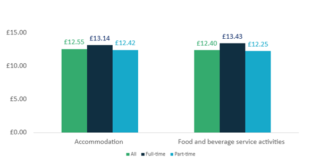
ONS Annual Survey of Hours and Earnings (ASHE) by hospitality sector for Wales
Under the current tourism model, the wealth generated from tourism is not circulated locally, but money leaks away from local economies. Tourism workers, who experience low pay and insecure, seasonal hours, are less likely to be able to find or afford rental housing. As a result, many Welsh communities are hollowing out.
How to create a tourism economy that benefits everyone
Policies such as council tax premiums on second homes and new powers for the Scottish and Welsh governments — alongside proposed UK government powers — to introduce a local overnight accommodation visitor levy can help address these pressures. However, gaps remain.
To make tourism work for rural Welsh communities, a bigger role for the social economy, community ownership including cooperative models, greater use of local supply chains in tourist activities, and land use policies can help create good, well-paid tourism jobs and support local economic activity.
A sustainable tourism model is about ensuring that tourism benefits people and places, where the economic benefits of tourism are distributed evenly and stay in areas like Wales.
CLES is currently working with partners across the UK to explore models of sustainable tourism. Look out for more on this in coming months and if you’d like to talk to us further about this research or how you are addressing this challenge in your area, please get in touch with oliverchan@cles.org.uk.
Jasmine Barry was a Q-Step data intern, and Oliver Chan is a senior analyst at CLES.