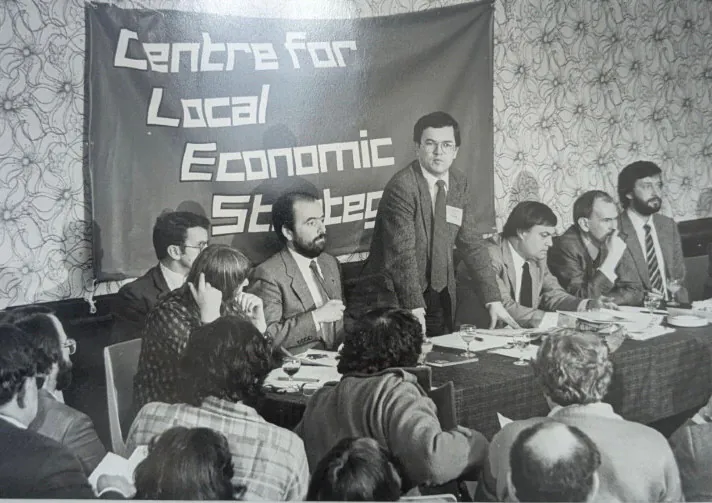
The work on local wealth building by the Centre for Local Economic Strategies (CLES) Centre stands as a socially rich alternate to the prevailing set of liberal economic development thinking. However, this has come with some negative critique. This piece seeks to answer that.
Local Wealth Building is a growing movement in Europe and the USA, and offers a different approach to a socially failing liberal economic approach. At its core stands a recognition that places have much public and private wealth at their disposal. Therefore, we must analyse this wealth, and seek to harness it for deeper economic, social and environmental benefit.
There is a range of levers that places can use for local wealth building. Of key importance are local anchor institutions (large, local, public, social and commercial organisations) and the role that their purchasing (procurement) power has in supporting the supply chain, including local business. They can create local benefits in the form of local employment, developing skills of local workforce, and generally enhancing the sustainability of business. Aside from procurement and this anchor role, local wealth building includes innovations such as community banks, and cooperatives as a means of locking in wealth, ensuring local investment, and building a more inclusive economy.
This work stands in stark social contrast to the dominant liberal economic approach. With a focus on large cities, this approach has focussed on city centre agglomeration economics, reinforcing ideas of trickle down, but adding a trickle outwards to poorer areas. However, it is not working. Our large cities are sucking economic energy and investment from outer areas and smaller cities, with wealth all too readily extracted by global investors, with little local social gain or generative benefit.
Our work on local wealth building, is aligned to social and economic democracy principles: seeking to ensure that the economy and the market delivers social outcomes at scale, and that wealth gain is broadly held. Specifically, our work in Preston with six large public anchors has seen spending on local businesses increase (£74m representing a 13% increase over last five years, with many local jobs safeguarded and/or secured). However, some within the economic development and city policy fraternity prefer to downplay these sort of local business and social gains, rushing to support the extractive economic status quo. This includes the labelling of local wealth building as ‘zero sum’ – simply transferring money from one place to another, critiquing the ability of local wealth building to deal with productivity issues and labelling this work as ‘local protectionism’.
Let’s take these criticisms in turn. First, the argument that this is ‘zero sum’. Shifting the geography of spend (in the short term) is about bringing economic activity where it produces the highest social return without reducing the productivity. Let’s be clear, the value of an additional unit of jobs is higher in a deprived area than it is in a non-deprived area. That is not zero sum. This work is an example of Pareto improvement – whereby for the same productivity we get more social benefit (and environmental – in terms of shortening supply chains). A crucial achievement in times of massive socio-spatial inequalities and austerity.
Second, the critique that this offers nothing for productivity. Local wealth building is a long-term strategy of increasing the productivity of businesses through reducing information asymmetries (where one party in an economic transaction holds more information than the other), opening markets to SMEs and engaging with suppliers. These local place factors are a feature of total factor productivity as they make the market more competitive, not less, as they enable more market access to more local SMEs, and not just to a few big extractive corporations. Local wealth building is local business development policy.
Third, the idea that this is local protectionism. Progressive procurement is not just about increasing the extent to which anchor institutions spend in a defined local geographical area; it is also about shifting the behaviour of supply chain organisations (regardless of where they are based) so they contribute to wider economic, social and environmental challenges. This is relevant for the national economy, not just the local. Developing local businesses, with more jobs, reduces spend on out of work benefits and other national public services and it increases the skills and competitiveness of UK business, generally.
For a more socially just economy, we must advance local wealth building, a movement in which a fairer, broader, generative economy serves people and local social need. In so doing, we must listen far less to those who have swallowed the liberal economics of political and financial power, which promotes a narrow extractive economy, which tends to merely serve itself.
Neil McInroy is chief executive of CLES and Matthew Jackson is deputy chief executive
By Neil McInroy and Matthew Jackson | 12 December 2017