Forty years ago, at the end of March 1986, the Greater London Council (GLC) and the other metropolitan counties were abolished. The threat of abolition had been present since the May 1981 local elections. After the general election of June 1983, it became government policy – part of a wider attack on local government, which included limits on how much councils could raise from local ratepayers – and later, the abolition of the rating system altogether.
But even as that threat grew, something else was happening. Since 1981, a number of councils had been developing radical approaches to the problems faced by their local economies – including the GLC, Sheffield City Council, Lancashire County Council, and the metropolitan counties in Merseyside and the West Midlands. This work was taking place against a difficult backdrop. In traditional industrial areas and inner cities, manufacturing jobs were in decline – a decline worsened by government policy after 1979.
The GLC, West Midlands County, and Lancashire all established local enterprise boards (the titles echoed the 1970s Labour government’s commitment to a National Enterprise Board). London and Sheffield cooperated on a series of public hearings to investigate cable technology. London and Merseyside launched an investigation into the Ford Motor Company. The GLC’s industrial strategy looked at childcare and housework alongside other sectors – it was probably the first policy document to identify the cultural industries as a distinct and significant area of economic activity.
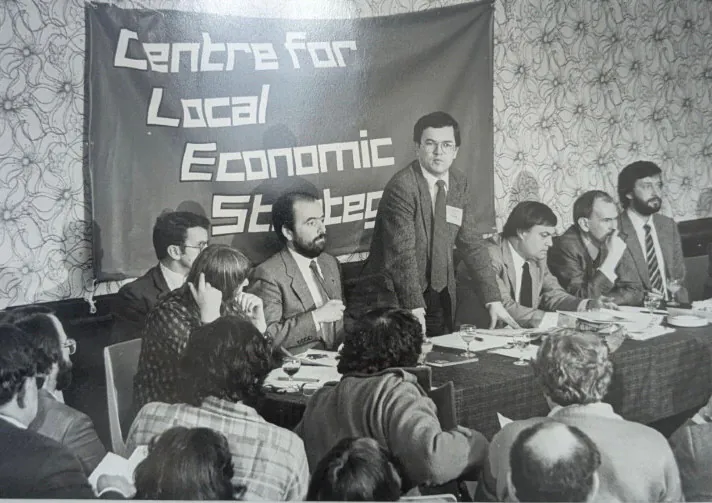
As abolition loomed, a more urgent question emerged: how could this spirit of innovation continue once the institutions behind it disappeared? These authorities came together to consider an answer. I have my files from the summer of 1984 onwards documenting meetings with David Blunkett and Helen Jackson in Sheffield, and Graham Stringer and Brian Harrison in Manchester, as we began to design what was called “the institute”.
A crucial early decision was that the institute – or centre – would be located away from London. It was argued that the press, trade unions, and politics were all based in London – so we should be too. No, said Manchester: we have just accepted that argument for the Local Government Information Unit (which started in 1985, with many of the same people involved); this must be in the North. Manchester offered to provide premises – and so Manchester it was. The first board meeting took place on 1 March 1985; the office opened in Albert Square later that year.
I chaired the board from the initial meetings in the summer of 1984 until January 1987. After a prolonged recruitment process, we appointed Marjorie Mayo and Irene Bruegel as joint directors. Both had families and other commitments in London, and during 1986 Irene left; in January 1987, Marj also stood down.
By this time, nine months after abolition, I was working as a freelance economic development consultant. I decided to resign at once from the CLES board and apply for the vacant post. After another lengthy recruitment process, I was appointed. I moved to Manchester and started work on 1 July 1987. Meanwhile another general election had intervened: Margaret Thatcher remained in power; the poll tax was on course for implementation.
I was – still am – fiercely proud of the GLC’s record, and of the extraordinary team we assembled to work on economic issues. But I was always clear that CLES could not run on nostalgia alone. So we developed new strands of work – on regional policy, on welfare-to-work, and on Europe. We always ensured that the things we said came from our own writing and research, avoiding purely party-political language. We worked with politicians – such as David Blunkett and the late John Prescott – who played a leading role in the new government that took office in 1997.
We also needed to develop new ways of working. By 1987, several of the councils that had funded CLES no longer existed. The others had very limited budgets. So, we developed two trading arms – one, running conferences and seminars for councils; the other, doing consultancy, for local authorities and other partner organisations. The core business of CLES became a registered charity, with a trading company – CLES European Research Network Ltd – undertaking consultancy. In the 1990s Atiha Chaudhry led the events business, and Mike Emmerich led the consultancy.
It was through CERN Ltd that we did our work for the European Commission. This included – in the brief moment of optimism that came after the Oslo Accords of 1992 – working on the EU’s Peace programme, promoting cooperation, knowledge exchange and learning between European local authorities and their counterparts in Israel, Palestine, Jordan and Egypt.
In the summer of 2000, I left the post of director, having been appointed chief executive of London’s Regional Development Agency. I remained in occasional contact, and in 2009 my successor, Neil McInroy, reconstituted the board, and invited me to take the chair – which I did, staying until the 30th anniversary ten years ago.
I am pleased to see that under the leadership of Sarah Longlands, CLES is going from strength to strength, and that so many authorities have adopted the community wealth building approach – evidence that the spirit that emerged under threat has not only endured, but continues to shape how places build their economies today.
Michael Ward is a former director and chair of CLES
To celebrate CLES at 40, former director and chair of CLES, Michael Ward, reflects on how the threat of the abolition of the Greater London Council (GLC) and other metropolitan counties raised an important question: how could the spirit of innovation continue once they disappeared? The answer was the birth of CLES.