CLES reaching 40 years is not just an organisational milestone: it is a moment to reflect on what progressive local economic change must mean in a context of economic instability, democratic disillusionment, climate crisis, rising inequality, and general social pain.
I was privileged to serve as chief executive for 20 of those years, from 2000–2021, a period in which our political operating context ebbed and flowed dramatically. Through it all, CLES remained a voice and anchor of progressive economic practice in a system that often pulled in the opposite direction.
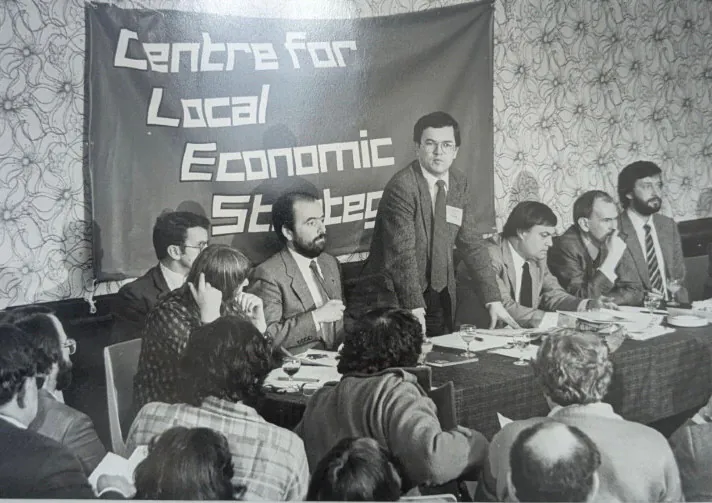
CLES was founded under the dark shadow of Thatcherism; a period marked by a sustained political assault on local government while deindustrialisation devastated towns and cities across the UK. The message was unmistakable: Britain was to become a service‑led economy dominated by financial interests. CLES was born at a moment when the post‑war social contract was being dismantled, and the power of capital was once again tightening its grip over people, communities, and labour.
CLES’s origins were a response to that hostility. It emerged as a place where councils and communities could advance progressive ideas, strategies, and action. That spirit of defiance and creativity was woven into the organisation’s DNA long before I joined. It is what I inherited, and it shaped every part of my two decades at the helm.
My time as CEO began in the New Labour period. It was a time of hope and some respite from what had gone before, but gradually a deepening and hardening of market‑oriented orthodoxy became evident. In my time the rhetoric of “regeneration” grew louder, yet the underlying structures of wealth, ownership, and economic power remained untouched.
Then came the financial crisis of 2008. It was a moment that revealed the UK’s financial fragility and the power of the state, which in response doubled down on an unfair financial model. The coalition government from 2010 embarked on the most severe retrenchment of the modern era. Whilst bankers were bailed out, local government, particularly in poorer areas, faced austerity and cuts. Many of the communities CLES worked with found themselves pushed into deeper precarity.
The 2010s brought further volatility: austerity’s continuation, limp climate action, and Brexit. Between 2019–2021, despite the advent of yet new regeneration language of “levelling up”, the fundamental logic of centralisation and short‑termism persisted.
The UK state remains institutionally resistant to structural economic reform. Its DNA rewards caution over creativity, centralisation over democracy, and economic orthodoxy over transformation. Trying to advance progressive, structural economic change inside this system is often too slow, always iterative, and usually frustrating. But it is a heady buzz when we succeed.
This is why CLES’s work matters. Advancing progressive economic change in such an environment is essential. With much pioneering feeder work on economic resilience and analysis of wealth flows, community wealth building emerged as a response to decades of extraction and economic failure. Community wealth building starts from a simple economic and social truth: if wealth shapes economies, then its creation and circulation must be redesigned.
During my leadership — especially amid the increasingly inadequate redistributive policies of New Labour — I met people, councils, and communities with deep-rooted radical economic instincts. They knew that handouts from the centre were never enough; something structurally different was required. From early work in Belfast, to the “Preston Model”, and now legislation in Scotland, community wealth building grew from the fringes to the mainstream; not as a social add‑on, but as a strategic economic framework.
Yet threats facing communities today are even greater than in the 1980s. Local government remains constrained within a centralised economic model that preserves more than it empowers. The promise of English city devolution remains shrouded in a central Treasury model that endlessly provides enough light to give hope, but never enough to truly enlighten, empower, and transform local or regional England. The UK state still prioritises stability for the established few over wellbeing for the many.
In such an environment, CLES’s role is essential. It keeps alive and works on the possibility of an economy shaped by communities, workers and place, not distant markets or private extraction. It supports institutions willing to do things differently and sustains the practical radicalism that inspired its founding.
40 years on, the struggle remains — but so do the possibilities. The operating context for CLES (as has always been the case) is laden with inertias and economic powers with vested interests who seek to preserve the status quo and see economic democracy as a threat. However, the next chapter for CLES will be written in a world that is increasingly precarious and so we need progressive economic change more than ever. That is precisely why CLES must continue to be bold, challenging, and steadfast in its mission. The need for economic justice has never been more pressing.
Neil McInroy is the global lead for community wealth building at the USA based think, do and change tank – The Democracy Collaborative. He is also chair of the Economic Development Association Scotland (EDAS).