Aligning community wealth building with just transitions
This workshop guide is the product of a major two-year international research partnership funded by the British Academy, led by…
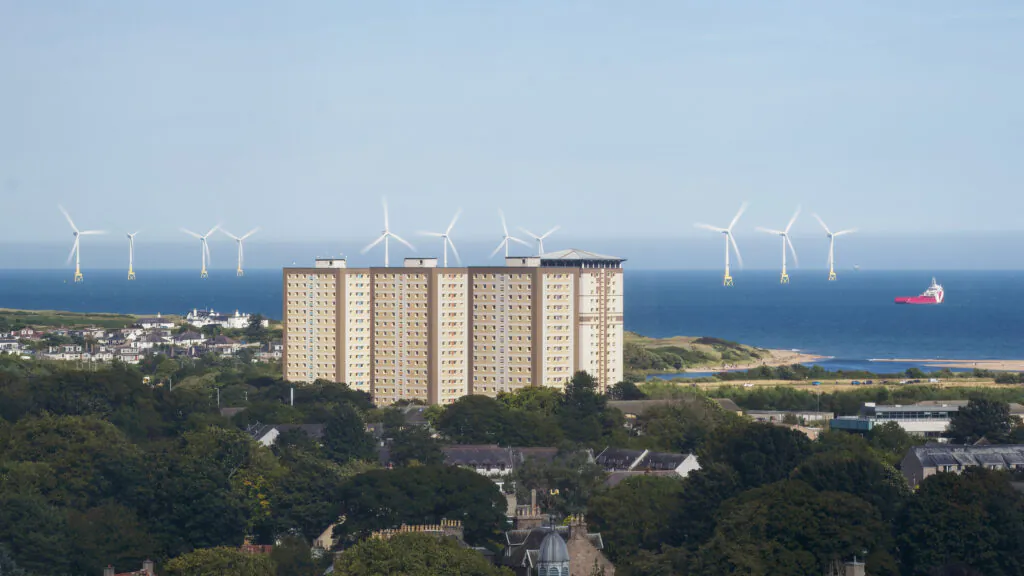

As the cost-of-living crisis threatens to drive a million people into fuel poverty and while around 19% of carbon emissions in the UK come from home heating, the just decarbonisation of energy in our homes has never been more important.
Since earlier this year, CLES has been working, in partnership with IPPR North, with Registered Social Landlords (RSLs) in the South of Scotland, to explore the possibilities of using a community wealth building approach to the energy transition through retrofit. The conclusions of our work, due to be published in early November, provide opportunities to challenge ownership and create jobs while also addressing the climate emergency and rising fuel bills.
“There is a choice”
Retrofit is an important area for community wealth building. Not only can the approach add significant value for communities – in retaining the economic value generated by the climate transition for their benefit – but also as a key point of development for the movement. There is a choice. We can choose to rely on the “usual suspects” to maintain the status quo, dominate the retrofit market and syphon the profits generated from public sector investment into the hands of their shareholders, or we can lay the foundations for an approach to retrofit that retains investment so that it benefits local people, businesses and places.
“The analysis […] backs this up, identifying huge economic and social potential from a progressive approach to RSL retrofit”
In Scotland, RSLs have been tasked with leading the charge on housing retrofit – which is viewed as critical in achieving Scotland’s ambition to reach net zero carbon by 2045 – with strict regulatory standards placed on the energy efficiency of RSL stock. The analysis we have completed so far backs this up, identifying huge economic and social potential from a progressive approach to RSL retrofit: in the South of Scotland alone, tackling retrofit whilst employing community wealth building principles could create tens of thousands of jobs and hundreds of millions of pounds in GVA.
“Rural economies […] risk falling further behind urban areas”
This work has also enabled us to examine in more depth the three interlinked challenges of comfort, climate and cost. For, while warm, affordable and healthy homes are essential to wellbeing and the need to upgrade social housing stock has been made even more pressing by the push for net zero and soaring fuel prices, the project has also shown that inflation and Brexit have made the delivery of retrofit more costly and challenging for RSLs. Rural economies like the South of Scotland face even more of a challenge in terms of delivery: without additional government support, they risk falling further behind urban areas which benefit from more buoyant labour markets and developed supply chains.
Crucially, though, within these interlinked challenges we have identified an interlinked opportunity – a virtuous circle that can tackle the issues together. Our upcoming report will be a call to action to all stakeholders: with more support something truly transformational can be achieved.
In our full report we will detail how to realise this opportunity, through a suite of recommendations around collaboration, tenant engagement and smarter funding options. The RSL retrofit opportunity in the South of Scotland is a precedent for what could be achieved across the UK – an energised local business base working with education providers and the government to deliver resilient and prosperous local economies, whilst mitigating and adapting to climate change. Our recommendations engage with the retrofit ecosystem as a whole, demonstrating that for one to succeed in this opportunity they all must move together.
“a unique win-win-win scenario”
Often in policy making there are trade-offs between cost, viability, and popularity. What we have identified in the South of Scotland is a unique win-win-win scenario. Done right, retrofit could mitigate against the worst effects of fuel poverty, tackle climate change and kick start the labour market in the communities that need it most.
Traditionally, community wealth building approaches have examined well-established markets and sectors to determine how wealth which is being extracted can, instead, be retained. By contrast, retrofit is a largely immature market, and with that comes a wealth of opportunities to understand how we can hardwire economic justice into the way it is delivered from the outset.
These opportunities must be realised – for the stability and prosperity of communities today and in the years to come.
Want to make your local economy fairer and stronger? Talk to us – we’re here to help you make change happen.
For press enquiries please reach out to us on rosielockwood@cles.org.uk, or by calling 07802 453340
Contact us