We must accept that the UK political economy, with its market liberal economic growth model, is intrinsically incapable of ensuring that wealth is fairly distributed. We are the fifth largest economy in world, but fifty-two percent of our wealth is held by the top ten percent, and 20% by the top 1 per cent.
This ‘Great Retrenchment’ of wealth has not happened by accident. Rather, it is the product of an intentional reordering of the global economy since the 1970s, where national social contracts and social safety nets have been eroded and the extraction of wealth has intensified. Market liberalism now infects all aspects of the UK political economy, ranging from the privatisation and commercialisation of our public services, austerity, to the financialisation of the economy. Added to this maelstrom has been the newfound hypermobility of capital in the age of globalisation, which has allowed wealth to avoid tax regimes and regulations in one country by skipping across the border to lower-tax alternatives.
What now remains of our social contract is insufficient: no longer able to patch over the internal contradictions of a political economic system where the state at best can only tinker around the edges of wealth, whilst deep inequalities are rooted into the very allocation of wealth in the first place.
But there is a fightback and it’s working: local wealth building. This movement should be understood as a refutation of our market liberal political economy and an attempt to develop an alternative strategy, which democratises and redistributes not just the proceeds of wealth, but the production of wealth in and of itself.
Local wealth building does this by inviting a paradigm shift in how we structure economic development in our localities. Rather than dealing with growth and wealth ‘after the fact’, it seeks to restructure the composition of the economy itself so that local economic and social gains are not an afterthought, but rather built in as an intentional function of the economy. As such, it is a process that ensures not only a more reliable set of outcomes including jobs and meaningful work, equity and inclusion, but also develops alternative models of economic ownership such as cooperatives and mutuals.
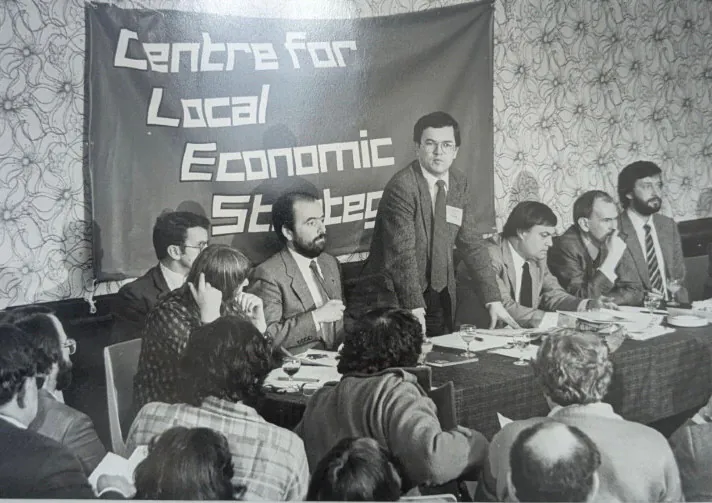
Work by the Centre for Local Economic Strategies with a number of Local Authorities and other local anchor organisations is at the vanguard of this movement. This work is bespoke in each place and is contributing to a democratisation of the economy which seeks to provide resilience where there is risk and local economic security where there is precarity. This is a reorganisation where wealth is extracted less, is more broadly held, and has more local roots. Ideas and action around Local Wealth Building are delivering real social outcomes and challenging local economic development convention.
For all the talk of poverty and its endless description, let’s start to focus on wealth: Who has it, where does it go and how do we get it to those most in need? We need to tackle poverty at its source: Local Wealth Building is the answer.