CLES at 40: rewiring the future of local economies
In the kitchen of the CLES offices in Manchester sits a framed black-and-white photo of the first meeting of CLES,…

The UK government’s £5 billion pride in place (PiP) programme is a 10-year investment in 339 communities across the country. Its stated aim is to give local areas “the resources and tools to drive change themselves.” For communities that have borne the brunt of austerity and the cost of living crisis, this represents a rare opportunity to rebuild local civic and economic infrastructure with long-term financial support.
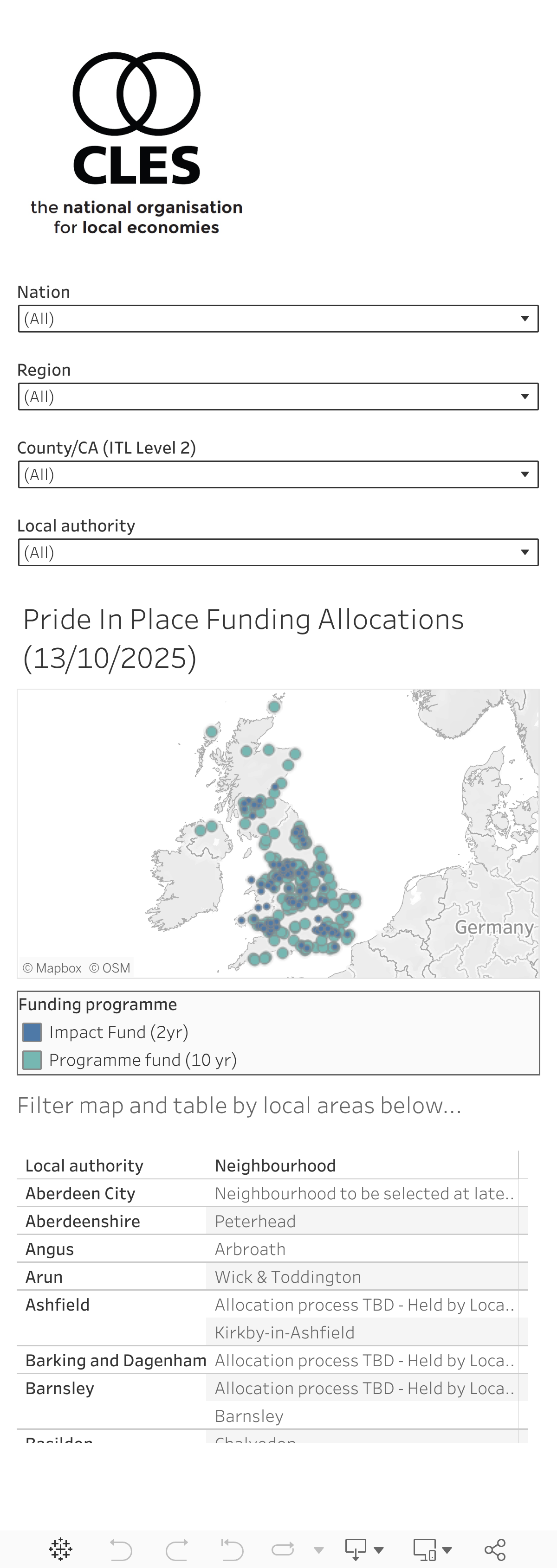
At CLES, we’ve mapped the areas receiving funding so that you can see how and where this will impact your locality. We then explore how and why we think Pride in Place funding should be approached through a community wealth building lens:
Programme Overview
As the map shows, the programme is split into two funding streams:
In both cases, the local authority acts as the accountable body to central government. While the scale and duration of the programme are welcome, there are risks which, if unaddressed, could undermine its progressive intent. Without a shift in how power and resources are distributed, much of this funding risks flowing into places then straight back out again, without creating lasting change. If the investment flows into businesses, infrastructures, and assets that are owned and operated primarily for private gain, and without genuine decision making from from communities, these resources will to leak back out in the form of profits, shareholder dividends, and rents.
This is where community wealth building (CWB) offers a powerful strategic lens. CWB is about changing how wealth and power flow in places—rejecting extractive, winner-takes-all economics and establishing economic and social relationships that retain, circulate, and generate value locally. As the originator of CWB in the UK, we see the Pride in Place funding as a massive opportunity for all in the movement – read more about CLES and the history of community wealth building here.
Encouragingly, the PiP programme’s list of pre-approved interventions includes many of the methods and approaches CLES have worked on and argued for over the years, including: community-led housing, cooperative and social enterprises, mutual banks, and community ownership of assets – all of which retain and circulate the benefits of economic activity more effectively by creating real power and control at a local level.
However, these models won’t just happen by giving decision making powers to a neighbourhood board. In many places this will require a shift in strategic framing, mindsets, governance, and commissioning practices from the local authority; and communities with limited experience of self-governance may not be aware of the options or benefits.
Genuine agency and control can’t be ‘delivered to’ communities, it has to be ‘enacted by’ communities. That means releasing centralised control and providing the right containers and support for local people to take risks and lead the change. Rather than stretching limited funds to cover perceived deficits, local authorities should treat this as an invitation to reimagine where wealth and power are held, inviting communities to explore new ways to meet their foundational needs. This requires working in partnership with curiosity, humility, and a commitment to deeper change.
The successful delivery of the programme’s ambitions will therefore depend as much on how things are done as on what gets delivered.
Addressing the risks and opportunities through a community wealth building lens
At CLES we’ve spent decades working with communities and local authorities on how to do economic development and regeneration well. From our experience we can see that there are several risks that could constrain the programme’s impact. These are set out below, along with the community wealth building opportunity:
Learning from Practice
Examples like Hastings Commons, Church Grove, Union Street and the Mondragon Corporation show what’s possible when communities come together to address their needs. It’s important to recognise that none of these things started with scale, or even a clear end point – they grew through a shared vision for something better, then collaborating, learning, and responding to local opportunities towards those ends. They demonstrate that with the right support and an enabling policy environment, communities can build self-expanding circuits of resources and agency.
How CLES and our Partners Can Support:
As the UK’s leading organisation for community wealth building, there’s a clear role for CLES and our partners in helping places make the most of this opportunity. Many organisations will offer templated solutions, but without a deeper understanding of why wealth doesn’t stick, these approaches risk repeating past mistakes.
CLES can support places by:
For examples of the kind of work we do, see our publications page here
The PiP programme should be seen as more than a funding stream—it’s an invitation to reimagine how places take control of the foundations of their wellbeing. With the right strategic framing, inclusive governance, and commitment to community wealth building, local authorities can become genuine partners in long-term change.
If you’re a council or community interested in applying a community wealth building lens to this opportunity, we’d love to talk to you.
Want to make your local economy fairer and stronger? Talk to us – we’re here to help you make change happen.
For press enquiries please reach out to us on rosielockwood@cles.org.uk, or by calling 07802 453340
Contact us