Aligning community wealth building with just transitions
This workshop guide is the product of a major two-year international research partnership funded by the British Academy, led by…

Up on a picturesque hillside near Donostia (San Sebastian) in Euskadi – the Basque Country – sits Hernani, a small industrial town of around 20,000 people with a long tradition of worker co-operatives. One such co-operative is escalator manufacturer Orona, formerly part of the Mondragon corporation – the world’s largest worker co-operative federation and the Basque Country’s largest employer
In 2013, left-wing Basque nationalist party EH Bildu won control of the town council and established a department of local development to support co-operation between local people, businesses and government to create new economic development projects.
During Covid-19, rising food insecurity, energy costs, care pressures and digital exclusion pushed the town’s approach to economic planning to evolve further. Hernani Burujabe was created to meet needs that neither the market nor municipal government could address alone, taking community wealth building beyond a set of policy tools, and turning it into a project to build local democratic economic power.
Hernani Burujabe’s approach is known as lurralde burujabetzare or “territorial sovereignty” in Euskara (Basque).
Territorial sovereignty recognises the limited influence local government has over market forces and seeks to democratise the economy. It gives communities greater ability to meet their own basic needs, by fostering more collective control over the systems that shape their everyday lives. The approach encompasses food, health and social care, energy, biodiversity, and promoting local financial services that operate outside of traditional profit incentives.
There are four principles of territorial sovereignty:
By applying these principles to Hernani’s local economy and working with other towns to apply interventions, Hernani Burujabe’s approach is intended to be part of a wider progression towards Basque independence centred on ecological and transformation across local Basque economies.
Each year Hernani Burujabe holds a complex democratic process to decide the town’s economic priorities.
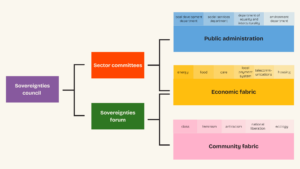
Residents, businesses and workers are not just consulted; they all get to shape the plan for the town’s economic priorities, alongside a “sovereignties forum”. The sovereignties forum promotes social ownership and seeks to embed social causes like class, gender, and racial equality, as well as ecology and Basque identity into all projects. Project funding comes from a combination of local, provincial, Basque Government and EU backing, and was worth around €2.5 million in 2025.
Since 2020, Hernani has made significant progress not only in meeting basic needs, but building institutions around them:
Through these projects, Hernani Burujabe uses community wealth building to build institutions that can retain wealth, deepen participation and give communities a real stake in the economy. This matters because it pushes community wealth building from simply a set of policy tools for local economic reform towards a roadmap for local economic self-determination. This is also done in a way that ensures class, racial and gender equality, while putting sustainability first.
Hernani Burujabe is part of a growing global movement to reshape the relationship between government, residents and local economies through approaches like community wealth building.
The creation of the “Preston Model” of community wealth building in the UK found strong inspiration from the Basque Country through the Mondragon Corporation – the famous federation of Basque worker co-operatives. Hernani’s approach to community wealth building is shaped by this political, cultural and co-operative context found in the Basque Country; therefore, a carbon copy in the UK is perhaps ill-advised. The lesson that can be taken away however is one of building local democratic economic power.
In the UK, community wealth building can sometimes be read too narrowly, limited to procurement, social value, anchor networks or support for local enterprise. Hernani’s case pushes us to ask a bigger question: who controls the systems that meet our everyday needs?
From Hernani to Preston, it is clear that community wealth building works best when it moves beyond isolated projects and becomes a practical strategy for local economic power.
Want to make your local economy fairer and stronger? Talk to us – we’re here to help you make change happen.
For press enquiries please reach out to us on rosielockwood@cles.org.uk, or by calling 07802 453340
Contact us