Aligning community wealth building with just transitions
This workshop guide is the product of a major two-year international research partnership funded by the British Academy, led by…


England’s SEND system is failing too many children and families. Support is too slow, too uneven and too hard to access. Parents are forced into battles for help from public services that should be easily available. Schools are stretched. Councils are under severe financial pressure. Children with additional needs are too often left without the support they need to thrive.
This blog argues three things.
First, that the SEND crisis is not only a crisis of rising need, underfunding and bureaucracy. It is also a crisis of where public money goes.
Second, when mainstream schools and local specialist provision do not have enough capacity, councils are forced to buy expensive placements and services from outside providers. Some of those providers are making significant profits from a system already under pressure.
Third, SEND reform must make sure public money is used to support children, families, staff and local provision, rather than extracted as excessive profit through opaque ownership structures that benefit distant shareholders.
This is what we mean by extraction: money intended for children’s education and support being pulled out of the system rather than reinvested in it.
The SEND system has not arrived here by accident.
For many years, policy has rightly moved towards supporting more children with additional needs in mainstream schools. The timeline of reforms is as follows:
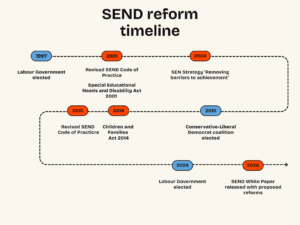 In principle, this is the right ambition. Children should be able to learn, grow and participate alongside their peers wherever that is right for them; however, inclusion cannot be delivered on goodwill alone. It requires funding, teacher training, specialist staff including teaching assistants, accessible buildings, manageable classes, good staff support and enough local specialist places when mainstream education is not appropriate. Too often, that support has not been there.
Instead, families find themselves navigating a system built around assessments, applications, Education, Health and Care Plans and appeals. Parents often must fight to prove what their child needs. Schools struggle to provide support without extra resources. Councils are left trying to meet legal duties in a system where there are not enough local places or services.
This creates unfairness. Families with more time, money, confidence and access to advice are often better able to push through the system. They may be able to pay for private assessments, challenge decisions or sustain long appeals processes. Families with fewer resources may face longer waits, weaker support and worse outcomes. A fair SEND system should not depend on how hard parents can fight. Yet that is increasingly what many families experience.
At the same time, local authorities have faced more than a decade of funding pressure. Many mainstream schools have not had the resources they need to support children earlier. State-maintained special school places have not grown fast enough to meet demand. Health, education and care services are often fragmented. Long-term planning has been weakened.
But councils still have legal duties to meet. If there is no suitable local place, they have to find one elsewhere. If they cannot provide support directly, they have to buy it in. This is where the market comes in.
The growth of independent special school placements shows how serious this has become.
The number of pupils with SEND placed in independent or non-maintained special schools has more than doubled since 2015, reaching nearly 30,000 in 2024. Around 70 per cent of independent special schools are run for profit. Average costs per pupil in these settings are now more than twice those in state-maintained special schools. This is not a small side issue. Although these schools educate a relatively small share of pupils, they accounted for roughly a third of the real-terms increase in SEND spending between 2015–16 and 2022–23.
Some children need highly specialist support, and some independent providers offer important and high-quality services. The point is not that every independent placement is wrong. The problem is the way the system now works. When councils have too few local options, they have less power to negotiate. When places are scarce, providers can charge more. When ownership structures are complex, it can be hard to see how much public money is being spent on children’s education and care, and how much is leaving the system through profit, rent, debt, management fees or payments between related companies.
This matters because some large providers are owned by private equity or investment-backed companies. These business models are designed to generate financial returns. Their first duty is not always the same as the duty of a public service: to meet children’s needs, support staff and build stable local provision for the long term.
The danger is clear. The more the state fails to build the provision children need, the more councils are forced to buy from a market shaped by shortage. And in that market, scarcity can become profitable.
SEND transport is often treated as a separate budget pressure. It should be seen as part of the same story.
When children cannot access suitable provision close to home, they are sent further away. For children, this can mean long journeys, early starts, stressful days and less connection to local friends and communities. For parents, it can mean worry, disruption and a sense that their child has been pushed out of the local system. For councils, it means rising transport costs.
Home-to-school transport spending has risen sharply in recent years, with SEND transport costs growing particularly fast, with average costs per pupil in now almost five times those in mainstream services. But this is not just a transport problem. It is a planning problem.
If local areas do not have enough inclusive mainstream provision, enough specialist places and enough joined-up support, children travel further to access education. The costs then appear in transport budgets, but the root cause lies elsewhere: the failure to build enough good local provision.
Transport spending is therefore a warning sign. It tells us that the system is not organised around children’s lives, local support or long-term value. It is paying the price of fragmentation.
The government’s proposed SEND reforms recognise some important problems: inconsistency, rising costs, delays and the adversarial nature of the system.
But reform cannot focus only on managing demand, standardising processes or controlling council deficits. Those things may matter, but they do not answer the bigger question: where is the money going?
If public funding continues to flow through the same market structures, the same problems will remain. Councils may receive more money but still be forced into high-cost placements. Families may still have to fight. Children may still be sent far from home. Providers may still make large profits from shortage.
SEND reform should therefore be judged against a simple test: does it keep more public money inside the system, where it can support children, families, staff and local provision? If not, it will leave one of the central problems untouched.
A better SEND system is possible, but it requires government to look not only at children’s needs and council processes, but also at ownership, profit and planning.
First, there should be much stronger transparency over providers that receive public SEND funding. Councils and the public should be able to see who owns providers, how much profit they make, how much money is spent on debt, rent and management fees, and where public money ultimately ends up.
Second, government should limit excessive profit-making from publicly funded SEND provision. National price bands may help, but they are not enough on their own. Rules are also needed to stop money being extracted through complex company structures, property arrangements, debt payments or other financial mechanisms that increase costs without improving support.
Third, local authorities need the funding, powers and staff capacity to plan SEND provision properly. They should be able to understand local need, plan ahead and shape the mix of provision in their area, rather than searching for placements in crisis.
Fourth, mainstream inclusion needs real investment: better funding for SEND support in schools, more specialist advice, better training for teachers and SENCOs, earlier intervention and a clearer expectation that inclusion is part of the core work of education.
Fifth, there needs to be more investment in state-maintained specialist provision. If there are not enough suitable local places, councils will remain dependent on expensive external placements. Building local capacity would help keep children closer to home, reduce costs over time and give local areas more control over quality.
Sixth, government should support more not-for-profit and community-rooted provision. Charities, co-operatives, social enterprises and other public-benefit providers can play an important role, particularly where they reinvest surpluses in children, staff and communities rather than distributing profits to shareholders.
Finally, commissioning should focus on long-term public value, not just buying whatever place is available. Councils should be able to consider ownership, quality, staff conditions, reinvestment, local presence and whether a provider helps build a stronger local SEND system.
The SEND crisis is often described as a problem of rising demand. That is only part of the story.
Need has increased. But so has the system’s reliance on expensive external provision. Too often, the state has failed to build the support children need, then paid a premium to buy it from elsewhere. Families have paid the emotional price. Councils have paid the financial price. Children have paid the educational price.
A different approach would start from a simple principle: public money for SEND should be used to support children, strengthen local provision, improve staff conditions and build long-term capacity. It should not be used to generate excessive returns from a system built around shortage.
Ending extraction will not solve every problem in SEND. The system still needs more funding, earlier help, better coordination and a stronger commitment to inclusion. But unless government addresses where the money goes, reform will remain incomplete.
The question is not whether children with SEND deserve support. That is beyond dispute. The question is whether we are prepared to build a system that puts their needs ahead of the market that has grown around them.
Want to make your local economy fairer and stronger? Talk to us – we’re here to help you make change happen.
For press enquiries please reach out to us on rosielockwood@cles.org.uk, or by calling 07802 453340
Contact us