CLES' work - Blog

Five lessons about anchor networks

The concept of anchor institutions – organisations rooted in a place that can play a defining role in creating and reinforcing local economic ties – has been present in the UK for over 10 years.

Frameworks for the future: new frontiers in community wealth building?

Earlier in 2025 we completed a piece of work for South of Scotland Enterprise. This fascinating and timely project involved consultations across various groups to co-create a Community Wealth Building Framework, which could be used in renewable energy developments to scale and amplify local benefits. We spoke to communities, their larger representative bodies, renewables developers and officials in the public sector. All agreed that developers should be contributing more and that we need a more consistent approach.
“the stakes are high, and we can, and must, deliver more for our people and places”
This can’t come soon enough. Communities across Scotland are increasingly frustrated at the scale of renewable development and the impact this is having on their places. These feelings are the symptom of a system where communities have, in some instances, been left out of negotiations, and ultimately do not feel they are reaping the tangible community benefits which these developments could bring for their areas. This is playing into a political environment where a push back against net zero aspirations and renewable technologies is gaining more airtime. The stakes are high, and we can, and must, deliver more for our people and places to enable us to tackle the climate emergency, support our rural economies and shift the narrative of extraction.
“natural resources can be owned, managed and shared in ways which benefit local people, local places and local economies”
Things can be done differently, however. We only have to look north to Shetland to see how their council negotiated with the oil industry to leverage a better outcome as part of the oil boom of the 1970s and 80s (although of course this did take an act of parliament). The council were able to secure financial recompense for every barrel of oil landed at Sum Voe, as well as rental income for the port itself which was used to fund social infrastructure across the islands. The legacy from this money, as well as residual funds, now forms the bulk of the Shetland Charitable Trust’s development support for island activities, as well as their reserves. And, we can see from other countries and other natural resources too, that different ways of working are possible. Natural resources can be owned, managed and shared in ways which benefit local people, local places and local economies. Our work in 2024 with the Scottish Land Commission exploring governance and mechanisms for securing value from natural resources highlights various case studies of best practice and showcases a set of guiding principles.

Boosting local economies. How can we grow what we aren’t measuring?

Early in 2025, the Scottish Government announced the world first Community Wealth Building (Scotland) Bill. This bill has reignited conversations around the opportunity that Community Wealth Building (CWB) could bring for Scotland and its people and places by enshrining into law new ways to build and retain wealth in our communities. This activity can support flourishing local economies, and considering SMEs make up 99.3% of all private sector businesses in Scotland there is a huge opportunity for this legislation to bolster their role in Scotland’s economic landscape.
“huge opportunity for this legislation”
CWB practices enable us to rethink and rewire our local economies around the people and places that they serve with the objective of increasing the flow, circulation and ownership of wealth. Using CWB, large public, private and third sector organisations (sometimes known as anchor institutions) working in collaboration can use their joint economic power including spend and employment to shine a light on how wealth and power leaks out of our economies, and how it can be redirected to benefit places. Traditionally CWB is delivered using five pillars, and for Federation of Small Businesses in Scotland (FSB) and their members, the procurement pillar is of particular interest.

Shaping special economic zones to work for communities

This article originally appeared in the MJ.

The special economic zones model is still too centralised, and government must loosen its grip if they are to work for local people, says Sean Benstead.

At CLES, we’ve spent the past few months – with support from the Alex Ferry Foundation – speaking to people on the ground and in policy roles to understand how Freeports and Investment Zones (which we’re calling Special Economic Zones, or SEZs) can deliver real benefits for local communities.

2024: our greatest hits

As the year draws to a close, our Chief Executive, Sarah Longlands, looks back at the last twelve months of CLES’s work.

It has been a turbulent 12 months, with change – both good and bad – very much at the forefront on the domestic and international stages. Yet, despite the uncertainty of the times in which we find ourselves, at CLES we remain simultaneously pragmatic and optimistic about the power of our mission: delivering local economic change. As we wrote in our general election manifesto – Our Local Economic Future – change may be dreamt of by aspiring national leaders, but it is both delivered and felt in communities.
“the growth of ideas, of confidence, of time and of resources”
But this kind of change doesn’t happen by invoking economic growth as the key to every lock. The kind of change that our communities need comes instead from the growth of ideas, of confidence, of time and of resources: to challenge preconceptions and tired economic assumptions, to think differently and with ambition.

Measuring success beyond growth

Senior Reseacher, Sean Benstead, reflects on work we have been doing in Oldham, to help the Council there understand how local interventions can deliver on their plan for place.

Since the start of this year, my CLES colleagues and I have been working with Oldham Council and the Oldham Economic Review Board to develop a framework to assess interventions related to Oldham’s Place Plan 2030 and it’s Independent Economic Review. These interventions span themes relating to skills and employment, civic pride, business and innovation, transport and housing.
“look beyond traditional metrics”
As the Oldham Place Plan strives to achieve broader positive life outcomes for residents through good and sustainable economic activity, the framework has been designed to look beyond traditional metrics for economic success. It operates as a live dashboard, with baseline analysis and SMART targets, which crystalise focus and supports the prioritisation of interventions in target areas.

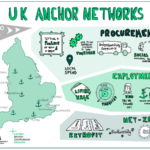
5 things you always wanted to know about anchor networks*

This article originally appeared in the Municipal Journal.

*but were afraid to ask

As the challenges facing the UK deepen and multiply, the institutions of our towns, cities and regions are increasingly motivated to work collectively to influence the creation of better lives for people in the places they serve. That is why, today, CLES are publishing our guide to setting up a network of anchor institutions.

From starting up a network to maximising its impact, from big city to satellite town, local authority-led networks to those that have engaged the private sector, How to Build an Anchor Network provides an overview of the different types of networks and the advantages (and disadvantages) associated with them, and how best to exercise your collective power once it is harnessed.

General election: resources for local economies

Following the Prime Minister’s surprise announcement that there will be a General Election on 4 July, you may be wondering what that means for you and your work in local economies.

We’re putting the final touches to our recommendations for what the next government should prioritise in its first 100 days, and a briefing for ministers on the great work being done by community wealth builders across the UK but in the mean time, we’ve collated some of our best resources for you to navigate the uncertainty.

Recruitment needs a radical rethink

This article originally appeared in the Municipal Journal.

The Government kicked off its election campaign last week on the back of much rejoicing about the latest inflation figures. It is clear to see some politicians are pinning their hopes on lower inflation equating to higher votes.

But the sight of Westminster politicians crowing about the numbers while steadfastly ignoring the lived reality that many families are still struggling to afford basics such as food, energy and rent, reveals how disconnected our national politicians are from life on the ground in our places.

A great leveller

This article originally appeared in the Municipal Journal.

Despite its clear flaws, the Levelling Up Fund is one of the few funding mechanisms councils can access to provide much needed investment in their places.

Launching this week, a new report from the Association for Public Service Excellence (APSE) and the Centre for Local Economic Studies (CLES) provides a guide for how councils can avoid falling into the trap of developing regeneration initiatives that extract wealth and deliver poor outcomes for people, place and planet, with a toolkit for projects to maximise their positive impacts locally.

Owning the workplace, securing the future

At the heart of the debate on community wealth building is a fundamental question about ownership and who or what holds the keys to wealth in our society.

In the midst of record inflation and a crisis where too few people earn enough to be able to feed their children and put a roof over their heads, tackling the unequal distribution of wealth ownership will be fundamental in helping to build a better economic model longer term.

The 51%

What if gender equality was at the heart of local plans for a more inclusive economy?

Efforts to rebuild and recover economic prosperity in a time of crisis often fall back on morale boosting images of – generally male – executives, gathered around a building site with hard hats. Economic partnerships and task forces assembled to help areas develop new plans for the future, too, can struggle with diverse representation, not only from women but from marginalised communities of all forms. Even the way in which we evaluate economic progress – in assuming that it will emerge automatically from economic growth – underestimates the importance of prioritising economic equality and diversity as a foundation to a more inclusive economy.

The brave

Four lessons from Scotland in delivering community wealth

At the close of the 2021 Community Wealth Building Summit, we reflect on remarks by our opening keynote speaker Tom Arthur MSP and the work that CLES has undertaken with the Scottish government over the last 12 months. The lessons learned should resonate with governments of all scales in Scotland and the wider community wealth building movement.

In his opening remarks to this week’s Community Wealth Building Summit, Tom Arthur MSP argued that community wealth building provided an “opportunity to approach economic development in a new way” in order to help create “common prosperity”. As the Scottish Minister for Public Finance, Planning and Community Wealth, Mr Arthur has put community wealth building at the forefront of his agenda arguing that it needs to sit across government, providing a “whole system approach” to an inclusive economy. He also confirmed the Scottish government’s intention to introduce a Community Wealth Building Bill during this parliament, to consolidate changes in practice and enable local anchor organisations to use their economic leverage to deliver more for local people and communities.

Re-think power to build inclusive local economies

This article originally appeared in the LGC.

Today CLES announces a new programme of work, exploring the powerful resonance between the international movement to “feminise” politics and the work we are doing to create more just local economies. Frances Jones and Eleanor Radcliffe explain the journey so far.

Thirteen years ago, the global financial crisis prompted human suffering across the world. In the wake of this, community wealth building emerged as an alternative approach to local economic development. In community wealth building, local authorities along with other public sector anchor institutions and social and private sector partners, work to disrupt the structures which enabled the crisis, building in their place local economies where people have far greater levels of control and ownership of wealth. At the same time, activists responding to the same inequality and suffering on their doorsteps, began to reshape the political landscape in their cities and communities, this time animated by feminist principles. Their work to “feminise politics” has become a global movement.

Community wealth building: a history

Today, CLES releases Community wealth building: a history, a transcript of our recent podcast, and the first publication under the banner of the recently-refreshed Community Wealth Building Centre of Excellence (CfX). Here, Tom Lloyd Goodwin explains why we felt that now was the time to delve deeper into the provenance of the approach.

Community wealth building reorganises local economies to ensure they are best placed to tackle the inequalities and disadvantages that are now, more than ever, so acutely felt by people across the UK. Over the course of the last decade, the movement has advanced from being a marginal sport. It has blossomed into a widely-adopted corrective to an economic model that has left too many people worse off, enriched the already wealthy few and propelled us further down the road to ecological disaster.
“this wider historical context contains a series of important lessons”
To celebrate this ever-flourishing movement, CLES recently released a podcast, looking at the provenance of the approach and, in this, we felt there was an important story to tell. A lot of people have heard about the “Preston model” but few are clear about its history, and how that relates to the movement we see now. Yet this wider historical context contains a series of important lessons.